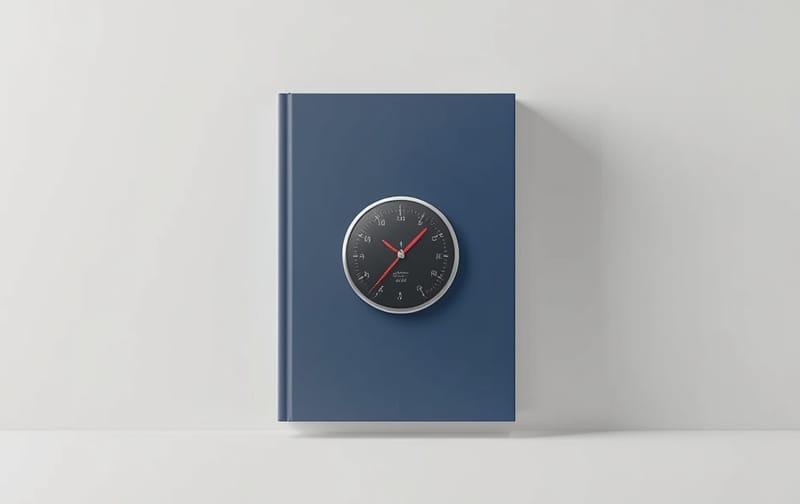
🌡️ A BOOK FOR WOMEN BUILDING A SECOND ACT
Be the Temperature
Stop reacting. Start regulating. Own every room you're in.
You can feel everything and still hold your own temperature. That is the whole promise of this book.
You have never once walked into a room as yourself
You take an inventory before you get out of the car — who is coming, what they will want from you, what mood the room is likely to be running, how you need to show up to keep everything from tipping sideways.
And the strangest part is that you do not notice you are doing it. It happens the way breathing happens. Automatically, continuously, below the level of conscious thought.
Then you drive home wrung out, and you cannot quite explain why. You were just at dinner. You barely talked about anything serious.
A thermometer reads the room. A thermostat sets it.
A thermometer has no capacity to influence, regulate, or hold its own reading. Put it in a hot room and it reads hot. It is entirely at the mercy of wherever it is placed.
A thermostat has a set point. When the room drifts — too hot, too cold, too chaotic, too frozen — it activates. It doesn't panic. It doesn't absorb the disruption. It doesn't become the disruption. It returns the room to its set point, steadily, from the inside out.
Most of us were trained to be thermometers. This book is about becoming a thermostat.
What's inside
- How the thermometer woman gets made — and why it was intelligence, not weakness
- The fawn response, and the accounting nobody ever does on it
- Catching fires you didn't start, and the three-second pause that stops it
- The identity leak — why "I don't know who I am" is a beginning, not a verdict
- What regulation actually is, and the four things it is not
- Finding your baseline, and why it feels boring at first
- What happens when the people around you notice you have stopped absorbing

Four parts, 13 chapters
Reading the Room. Breaking the Glass. Setting the Temperature. Owning the Room.

About 27,000 words
Short on purpose. You'll finish it.

Audiobook available
For the drive, the walk, the folding of laundry.
This book was written for a specific woman
She's somewhere between 35 and 55, though the number on her license is almost beside the point — she carries a different kind of age, a bone-deep one. She survived something. Maybe several somethings.
She is not broken. She is extraordinary. But she is tired in the particular way that comes from years of being the one who holds it together, reads the room, smooths it over, keeps the temperature livable for everyone else while running on empty herself.
She is ready to stop.
What this book is not

Not about becoming calm
Calm as a performance is just another way of adjusting yourself to what the room needs. A thermostat isn't emotionless — it's regulated. Those are completely different things.

Not about being better
You are not a problem to be optimized. The hypervigilance, the attunement, the absorption — those were not failures. They were adaptations. Extraordinary ones.

Not about feeling less
The capacity to feel a room is not your wound. It's your gift. The wound is that nobody taught you the difference between feeling a room and becoming it.
Two ways to read it

$27 — The book
The complete book as a PDF, yours to keep and read on anything. Four parts, thirteen chapters, every Temperature Check exercise.

$47 — Book and audiobook
Everything above, plus the full audiobook. For the drive, the walk, the folding of laundry — the hours you already have.
If it isn't for you
[Add your refund terms here — for example: if the book isn't what you needed, reply within 30 days and I'll refund you, no explanation required.]
No. Recovery is part of the author's story and it appears in the book, but the thermometer pattern is not specific to addiction. It shows up in anyone who grew up learning to read a room before they could read a sentence.
It's around 27,000 words — short on purpose. You'll finish it. The audiobook bundle exists for the same reason: the hours you already have are in the car and on the walk.
One chapter looks at faith as an anchor, and it is written for three kinds of reader at once — the woman for whom faith is a comfort, the woman for whom religion was a wound, and the woman for whom it is simply not her framework. Nobody is told the missing piece is Jesus.
Honestly: reading the book is not the same as doing the work, and the book says so in its own conclusion. Insight is the beginning of the possibility of change. What makes it stick is the practice, and the practice chapters are there for that reason.
Through Gumroad, immediately after purchase. The PDF downloads straight away; the bundle includes the audiobook files alongside it.
You have always had a temperature of your own
Underneath all the adapting and the absorbing and the years of reading rooms that were never yours to regulate — a specific, irreducible self with a specific, irreducible set point.
You just hadn't claimed it yet.
Be the Temperature by Marta Daniels · Recover Out Loud
We recover out loud so others don't have to suffer in silence.